> For the complete documentation index, see [llms.txt](https://docs.zumrails.com/llms.txt). Markdown versions of documentation pages are available by appending `.md` to page URLs; this page is available as [Markdown](https://docs.zumrails.com/getting-started/your-zum-rails-account.md).
# Your Zum Rails Account
## Sandbox
Zūm Rails offers a sandbox environment for our clients to test integration and familiarize with the different areas of the product. Clients will be able to access the portal, use our APIs and SDK for testing purposes while using the sandbox environment.
You can reach out to our sales team to book a demo and get access to your Zūm Rails Sandbox environment.
[**Contact Sales**](https://zumrails.com/contact/)
In the sandbox environment, you can get access to your API credentials, test creation and management of users, payment instruments, transactions, and webhooks.
### **Get Access to API Credentials**
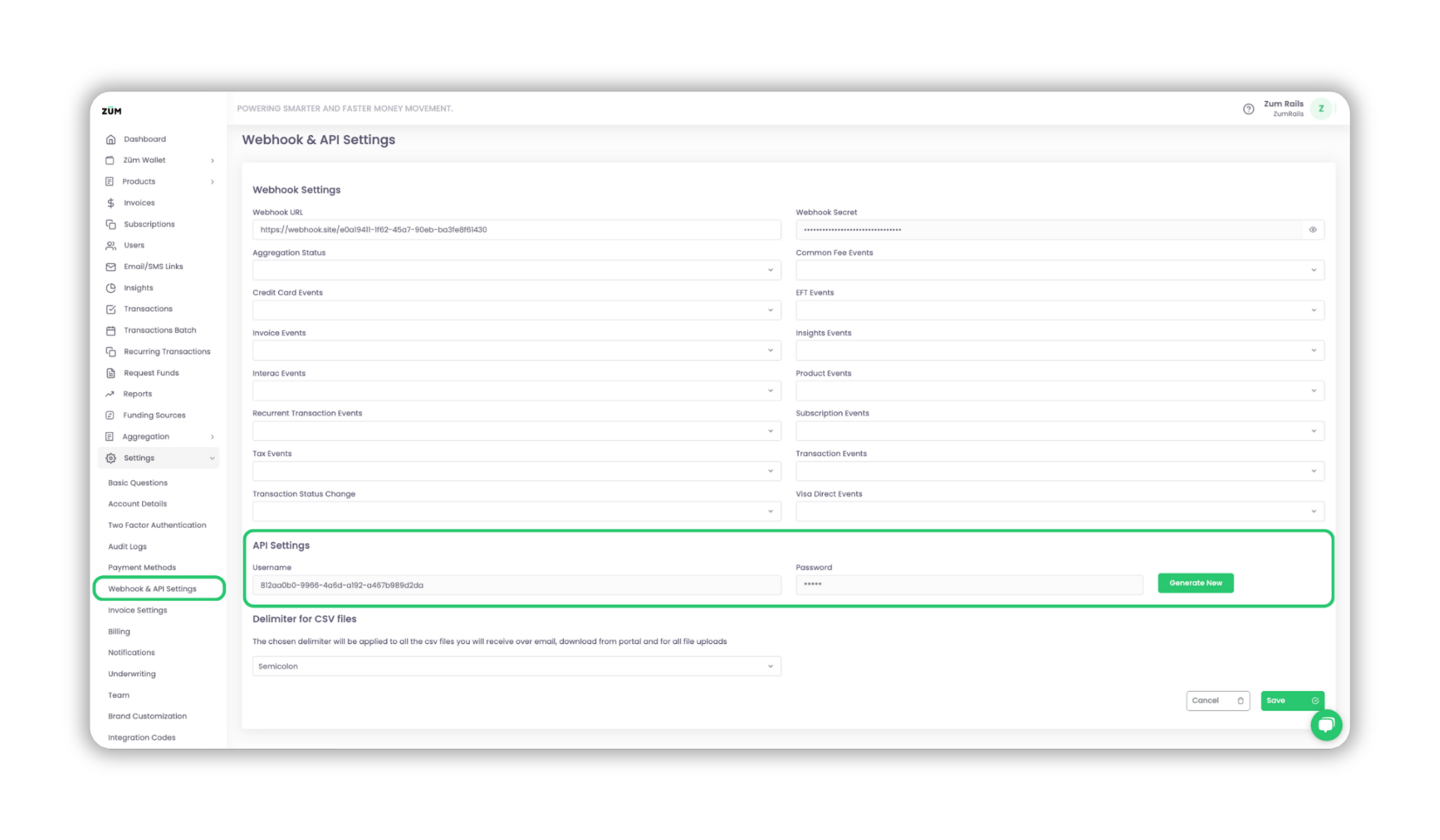
Once you have access to the portal, obtain your API username and password by going to \
**Settings > Webhook & API Settings > API Settings.** These credentials are vital for accessing Zūm Rails services securely.
### **Start Testing**
* [Create & Manage Users](/getting-started/quickstart.md#create-a-user)
* [Transactions](/api-reference/transactions.md)
* [Webhooks](/api-reference/webhooks.md)
## Production
Once your team has setup their sandbox environment and concluded the testing and integration, you can mirror your integration in the production environment to move money between your users. Reach out to our sales team to get started with using Zūm Rails in production environment.
---
# Agent Instructions
This documentation is published with GitBook. GitBook is the documentation platform designed so that both humans and AI agents can read, navigate, and reason over technical content effectively. Learn more at gitbook.com.
## Querying This Documentation
If you need additional information that is not directly available in this page, you can query the documentation by asking a question.
Perform an HTTP GET request on the following URL with the `ask` and `goal` query parameters:
```
GET https://docs.zumrails.com/getting-started/your-zum-rails-account.md?ask=&goal=
```
`ask` is the immediate question: it should be specific, self-contained, and written in natural language.
`goal` is what the user is ultimately trying to achieve, the reason they need the answer. Sharing it helps GitBook give you a better, more relevant answer. A goal is most helpful when it describes the outcome the user wants rather than restating the question. For example, with `ask=how do I create an API token`, a goal like `automate deployments from our CI pipeline` lets GitBook tailor the answer to that use case.
The response will contain a direct answer to the question and relevant excerpts and sources from the documentation.
Use this mechanism when the answer is not explicitly present in the current page, you need clarification or additional context, or you want to retrieve related documentation sections.